Revisiting and the present day: France, London and Japan (well Hokusai)

It really is quite an odd feeling revisiting such a once in a lifetime adventure a year on.  As with the adventure itself, it’s proving quite unpredictable: both lovely and a bit unsettling.

Day three a year ago was Calais to Montreuil and the first full day out of the UK.  It was quite a challenge with cool to cold headwinds and a constant roll up and down of little hills as I first headed off down the minor roads near the coast.  By late morning I decided there were no real gains in terms of views, as the sea was out of sight to my right, and I opted to turn sharply inland before hooking back onto a more major but still unthreatening road south.  I think this was the day that I started to be aware that I was going to need quite a lot of food (though the perhaps the pound shop chocolate was really the first acknowledgement of that).  That was a bit of a challenge as I had been more oriented to thinking of losing weight, or trying to avoid gaining it, for a few years by then.

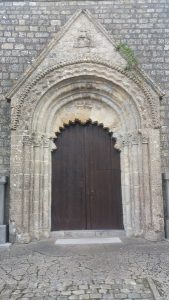
I can remember two grub stops, one at a large hypermarket in the middle of nowhere where I stocked up with food, and the other in a tiny hamlet whose name I’d lost.  However, coming to 2017 and by the technlogical miracle that GPS in my ‘phone stamped the EXIF data in my ‘photos with latitude and longitude, and the complementary miracle that I can just type those into Google maps and, hey presto, I find that the lovely little church which persuaded me to stop and munch some more was at Le Wast

Church door Le Wast
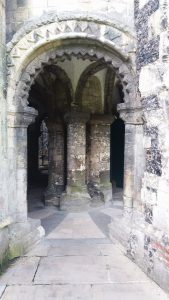
Detail of door


Another nice trick means I can just paste that information in here so you can look at the location on Google maps if that appeals to you. I can see I am going to have to do some more sleuthing to get better at handling these images and going back to mapping things.

But what about today?   I think I can’t do this revisiting to the exclusion of the present day and perhaps I really need to bounce back and forward between last year and this to start to link the two into a more coordinated and fertile meld.  It helps that today was a bit of a pilgrimage day and it involved a bit of cycling too though only a 19.8km round trip from home to the British Museum.

This was another of my trips with my daughter.  I had persuaded her that she really should see the amazing exhibition of Hokusai’s work before it finishes Sunday week (13/8/17).  This was my visit and each time I’ve been it been absolutely packed, you crawl around in a long queue moving very, very slowly as everyone, or pretty much everyone, is locked into the amazing prints and paintings.  It’s that packed despite access for non-members, who are paying quite a lot (£12) to get in, being rationed to keep it from being unbearable.  It makes having paid for family membership at the BM a joy as we can just walk in and join the tail of the queue.

I’m not sure I’ve ever found myself getting round an exhibition so slowly, and in such a millipede of fellow gawpers.  Oddly it brings back memories from young teenage years in the very same museum going to the famous Tutankhamun exhibition (hm, bit of sleuthing: 1972, so I was 15).

I had warned daughter of the queue and she’d worried that she might kill someone as, like me, she doesn’t like people in her personal space nor being constrained by a crowd in what she can do.  I probably shouldn’t have worried but I was relieved that she was completely engrossed.  I guess we found ourselves talking about probably over 80% of the exhibits as we went around, mostly alongside each other.  Hokusai has a very high and sacred position in my odd pantheon of humans who have fundamentally changed my way of seeing and experiencing the world and its possibilities.  I think, perhaps hence the recollection of Tutankhamun, that probably goes back to around that time, perhaps earlier.  I know I went to a Ukiyoe exhibition (BM again I’m pretty sure) with my father at some point in my teens or student years, but I think that was bit later.

This huge exhibition seemed very well curated to me and I learned a lot I hadn’t known about my hero.  One thing was how often he had changed his name, ending up with Gakyo Rojin: “old man, crazy to paint” (and daughter suggests I should now be dubbed “old man, crazy to cycle”!)  I also learned for the first time just how deeply his particular Buddhist faith had influenced him and that a part of it was, or became, a deep belief that all things, animate and inanimate, have a spiritual meaning and connectedness. I wonder if something of that has always communicated to me from his works.  As I did a lot on the ride a year ago, I am pondering exactly what that means to me but boy it does hit a chord for me.  That’s something I was able to immerse myself in on the ride last year but something I find harder to touch and hold in the pressures and mundane artificialities that so easily become my life day to day when I don’t grasp opportunities as we did today.

If you can, and can bear the queue and have some hours in London between now and Sunday week: I’d recommend the exhibition.  Ouch, sold out: if you can afford it, buying BM membership will get you in, I honestly think it would be worth the money but clearly I’m hopelessly enamoured of Hokusai and his work.  If that’s not on, I can also recommend pointing a bike towards Santiago de Compostella, or any other reasonably distant, transcendent, target, or starting to plan that.  Electric bikes are fine by the way!

Revisiting the pilgrimage a year on: day two

Wow, I have just looked over the “pelerinage” site, at my ‘photos and my route tracking and realised just how little I mounted.  OK, work to be done!

Hm, ain’t that always the way?  One very important part of the ride was stepping out of that framework and being able to say either “No there isn’t!” or “Yes there is: just turn the pedals and keep Toto heading roughly south!”.  To be honest, I never entirely stopped thinking there was work other than pedalling to be done.  Right from day one I was telling myself there was a site and blog to create/write (and how little of that I achieved!)  From about day three I continued to answer many work related Emails. That was a bit easier than it might have been as I no longer had a clinical Email address.  Assuming that the Out-of-Office message I had set the week before before dashing across the road to my leaving do (see One year on and where am I?!) worked, then that told people I had left and referred them to sensible others.  Other Email addresses I had also had OoO messages saying I was off on this pilgrimage, not working, and that I was unlikely to answer Emails.  In fact, I answered a fair few.  I think I helped finish at least one grant application and worked on some paper submissions.  I’d be quite amused to look at the sent folder for the period to see what I did do.

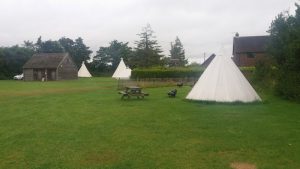
But day two was a new world.  I had had my first night in my little tent with food and beer, and tiredness and satisfaction, despite some set backs, perhaps because of some set backs, all helping me sleep.  I know I slept very well.  I woke feeling great, a bit to my surprise and I was amused to rise easily to an early alarm (while my ‘phone still had some battery).  I remember padding across wet grass in bare feet with a towel wrapped round my waist to shower and scrub my teeth.  I remember admiring the fixed teepees in the camp site and saying a warm good morning to some others, then I packed the tent up, which proved fairly easy, another relief, and off I went.

Teepees and damp grass under my feet

I remember the run in into Canterbury went through a lovely long phase following the river, “The Great Stour” I see is its proper name.  It’s great in aesthetic terms but in volume, width, grandeur, that’s a faintly strange name as it’s not a very big river at all.  Perhaps my scales are a bit distorted by living a few miles from the Thames!  As ever when you follow a mature river you are sweeping a fairly direct but generally sweeping set of curves as it meanders along and across its near flat flood plain, and that was certainly the case with the Great Stour.  I hoped to see kingfishers but didn’t, but there was a heron and the sun was out and the a true sky blue with lots of very white cumulus and not threatening any rain at all.  The Constable paintings of the cathedral came to mind long before I got a sight of the steeple.

Canterbury nave
Canterbury side chapel

Then the wonders of the cathedral.  I think I have seen it before but I struggle to think when.  Perhaps I really hadn’t.  Some things felt familiar, mostly the exterior and I really do wonder if that was from paintings and ‘photos.  It was truly glorious: it’s a town in itself really as so many of the great medieval cathedrals are with their accretions of buildings sort of flanking them and creating a barrier territory between the gloriously sacred and the boondocks around where the laity lived and working.  There’s a buffer or border zone of dwellings and offices for monks, nuns or others with sacred offices.  For me it was absolutely crowned by seeing that the cathedral had a nesting pair of peregrines on the main steeple.  My new binoculars, bought specially for the trip, came into play for the first time for them and all the gargoyles and other features up on high, inside and out.

In the town I managed to find a cheap pair of glasses to replace my expensive ones which had chosen, not for the first time, to snap with zero provocation somewhere on the downs the day before.  I had picked them up to read the map on the tablet and one of the arms had simply broken off in my hand, seemingly mocking me with the challenge of balancing them on my great big nose and just one of my big flappy ears if I wanted to be able to read anything.  Clearly planning to make the journey all the more interesting.  I was greatly amused and felt a rather vengeful satisfaction that two pounds bought their replacement (in a “pound shop” as I remember it: something nominally or arithmetically awry there but I wasn’t complaining!)  I think that was somewhere between 1 and 2% of the cost of the ones those were replacing!  I also stocked up with chocolate there (also more than a pound but absurdly cheap).  Then, despite a real urge to stay and soak up the cathedral until it went dark, I headed off for Dover.

Coming into the docks in Dover I joined another cyclist, probably a year or two older than me and more in denim/cotton than lycra.  He turned out to be Dutch and finishing a six week solitary camping and cycling trip around the UK which had been great apparently, though it had rained every single day!  He was impressive but made me feel a bit feeble.  He had a hub dynamo, like me, but also a solar panel on his bike and he said that he’d needed both to keep his old ‘phone working.  He said that the solar panel had worked usefully despite the grey weather.  As by now I had used up most of the power in my various batteries and discovered that he was quite right that the dynamo hub alone wasn’t going to charge everything, I took note.

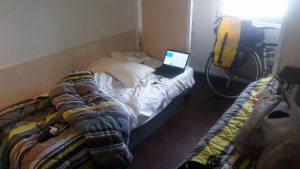
And that really came back to bite me in Calais that evening as it went dark and Google maps first led me miles, OK, kilometres, away from my hotel, which was really very near the dock … and then in quick succession the tablet, computer and ‘phone all gave up on me. That left me exercising my very poor French asking for a hotel, way away from it, in by now a rather cold, dank, late evening.  It was clear that the trip was going to have its ups and downs!  I found it in the end and the big bouncer on the door let me despite the pre-paid automatic entry system failing.

A real bed, a resting place for Toto and power charging the appliances

I must stop.  I’ll add some of the ‘photos tomorrow.  Always work to be done eh?!

Revisiting the pilgrimage a year on: Tuesday 2/8/16. South London to Doddington.

I hope this is going to be an interesting adventure to revisit the ride, day by day, one year on.

One immediate shock looking back at the blog was to realise that I didn’t actually manage to start it until I was over the border into Spain.  Some things fade with the vagaries of memory, others feel very clear. I’ve always had what seem to very different storage for different sensory modes and experiences, so some visual experiences seem to store and be recallable with great clarity, though not always to be recallable to order, and it can be odd what prompts assist recall.  Since the ride I’ve had this phenomenon of “positive anti-traumatic flashbacks”.  I think I’ve had them much of my adult life but perhaps been too busy or active with other things to notice.  What happens is that I’ll get a flashback image of something, almost always good, though sometimes it’ll be of a more difficult time, a slog up the mountain of O Cebrero heading into the cloud with gearing too high for my legs and the load.  Oddly, it happens mostly if I’m doing different, boring exercise (the last five or more years I’ve tried to do some exercise daily: anything to keep fit enough to do more long rides).

By contrast, remembering names was never my strong suit and has become much worse in recent years and I think it’s related to that, and my very different storage systems for the visual as opposed to the written, that I really had forgotten that the site stuttered into existence early(ish) in the ride, but that the blog was so much later.

Enough navel gazing!  What do I remember?  Well certainly a lot of excitement but also a definite frisson of anxiety as I headed out the door and onto the South London roads.  I know it had taken me hours longer than planned for me to feel that I had everything I really needed properly aboard Toto … who wasn’t Toto back then.  Even then I was pretty sure some of the deliberations about what I really needed, about what was unnecessary weight and what was vital, were probably more about putting off the precise moment of departure than any make or break decisions. I remember well that it was a damp day, not unlike today, though it never poured as it did here this evening.

Off I went and gradually hit a good enough rhythm.  However, there were some early warning fights with Google maps.  I remember a spectacular one where she took me into a tiny dead end off a side street above a bit of motorway (M25?) or a very busy dual carriage way.  That was particularly surreal though fairly easy to resolve with a bit of common sense.  I remember a bit of panic in the early evening as I realised I had no chance of making it to Canterbury, let alone doing the cathedral and getting on the ferry and away.  (That had gone as a realistic prospect by the time I belatedly left home in all honesty.)

I did a bit of a dog’s hind leg off the sensible route to Canterbury in order to find a camp site that had space.  I remember that the owner seemed grumpy and unwelcoming but his daughter was compensatorily friendly. The site had no mains power so my ‘phone, garmin and tablet were doomed to die on me the next day.  The site was up a nasty, steep little hill from the pub which was the only option to find now rather badly needed calories.  I know that the food was very much “UK pub so-so” but it was meat and two veg and a couple of beers so it ticked carbohydrates, fats and protein and certainly ticked calories.  Probably even ticked precautionary analgesia though not, I suspect, many vitamins.

The publican, his wife the cook, and the student who was doing her holiday job there behind the bar were all friendly and a relief compared to some rather smug, public school sounding teenagers (including some Americans?) who seemed to be doing some falconry related training near by who left mid evening.  I remember good chats with both the publican and student: about their pasts and their plans for the future.  By now I am sure he must have moved on to a different pub (in Ryde?), much more where he’d always want to be, as I remember it.  I think he had the purchase of that pub (tenancy?) and the sale of the one we were in fixed.  She wasn’t sure where she was going but was clear that that village location, where she’d lived for some years before going to university, wasn’t a long term option, now she had seen the lights of the city.  Where was she at university?  Lost that.  She was reading psychology at least as part of her degree and was interested to hear a bit about clinical work.

Funny what you remember and what you don’t.  Or let’s be honest, that should be, “funny what I remember and what I don’t”.

Enough.  Oddly both reassuring, but also a bit disturbing, to resurrect this.  Tomorrow was another day, if you see what I mean, and it was warmer and … but that’s for tomorrow!

Culture change, and cycling provision as an example

The last month or so brought an enriching new experience into my life, and guess what: it involved cycling!

What’s been interesting about this though is that it’s been a sort of vicarious experience, and the vicarious bit has been scary and sobering: seeing London cycling through another’s eyes.

This all started when my 23 year old daughter decided that she really should start cycling everywhere she reasonably can in London.  She’s back home and entering the final year of a four year degree at University College London (UCL), about 11km from home by bike.  She’s always been a stalwart user of public transport and passionately politically aware, socialist and particularly focused on gender, sexuality and disability equity issues.  I think she’s always sympathised with one of my arguments for cycling here in London: that my doing it frees one more space on London’s often horrifically overcrowded public transport for others who don’t have the choice to cycle.  However, until now she has said it seemed too dangerous and unattractive.

I’m not sure what changed her mind, perhaps her younger brother cycling quite a bit in London, though his cycling is almost all just around where we live.  Maybe him cycling pretty much everywhere he needs to when he’s at university up in Glasgow changed things.  I know it was partly that it was a way to get steps onto her fitbit and get around town while saving herself money!

Anyway, she asked if I’d lead her on some of the main trips she could do. We worked out that could take over the bike I’d had in Nottingham when my weeks were split between there and here and it, as luck would have it, it turns out that she likes it and that it can fit her pretty well.

So I’ve been sort of learning to cycle in London for a second time.  However, this time through the eyes of a very fit, risk and conflict averse, 23 year old, not a battered 60 year old who has been cycling most places he could for much of his life, certainly for most of the last 50 years.  It’s been an interesting experience as it has really brought home to me how desperately unfriendly to cycling London still is, and just how bizarrely incoherent much of the cycling provision has been.

One example is the cycle track on the Vauxhall Bridge Road to the north of the river.  This is one of the genuinely protected bits of cycle track in London.  That’s to say that there’s a kerb between the cycle track and the road. That’s great in principle as it’s so much safer than sharing the road with motor traffic.  This particular track is also “contraflow”: the track is two way to one side of the road so if you’re cycling north here, as we were, you are on the right hand side of the road with the motor traffic going the opposite way just across that kerbing on your left.  (International readers remember that in the UK we ride/drive on the left hand side of the road, the opposite side to most of the rest of the world).  I don’t much like contraflow cycle lanes as they almost always involve a point where you have to stop and cross the motor traffic and you’re usually waiting some time to be given permission to do that.  Because of this, though it’s been there for a couple of years, I’ve always stuck to the usual road going north on this route, eschewing the cycle track.  However, with my daughter’s safety in mind, I took the cycle track this time and we bowled along toward Victoria … and suddenly, with what seemed to both of us almost no warning, the track stopped.  There was a turning to the right up a side street, definitely not where we wanted to go, and the alternative was to haul on the brakes, shuffle up to the pedestrian crossing and hit the button and wait for that to stop the traffic on the main road and give us a chance to cross that and regain our northbound journey, now with no cycle track or protection at all.

Going the other way on that cycle track you have another daftness: the irritation of being stopped for minutes at at least two crossroads with minor side roads.  Cycling in the cycle lane you’re forced to wait when cars, and you had you chosen to eschew the cycle lane, could zoom on with the full priority of the main road.  Why so?  Because the road planners have correctly decided to protect cyclists from one of the principle killers of our kind: the “left hook without looking properly” death blow.  Great!  I love it when planners look after my hide.  I love it infinitely more, if the mathematical/obsessional among you will forgive the hyperbole, when they protect my daughter’s life.  However, why should cyclists wait minutes at each junction to stay safe?  It’s the same in the cycle lane on Blackfriar’s Road going north, another road I know well.  I’m losing minutes of my life every time I take these routes.

(I know, I know, I should slow down, be less impatient, get a life … and yet sometimes you really are in a hurry and, hey, the same can be said to the car and lorry drivers: if they just looked before hooking left in a hurry no-one would die and we wouldn’t need this daftness.  And while you’re on at me with this “slow down, get a life” stuff, yes, I notice that I lied there: we would all still die but not from the famous hook left, motor vehicle squashes human flesh, death blow.)

There is a very simple answer, far, far better in the long run than these infuriating lights that hold cyclists back for minutes while almost no motor vehicle actually does turn left around us: give onward traffic automatic priority even if that onward traffic happens to be a bicycle on your inside.  That doesn’t stop idiots hanging a left too fast, without looking and hence squashing and killing us, but it makes it far, far harder for them to get away without being charged with anything less than causing manslaughter by careless driving and, in the long run, it would change priorities and thinking.  All it takes is a small change in the law, one other countries have already adopted, see https://www.britishcycling.org.uk/campaigning/article/20170627-campaigning-news-Highway-Code-rule-changes-could-cut-traffic-queues-by-almost-half-0.

Now that brings me to my wider pondering: this really is an issue that kills people. I won’t put the factual links here but just remember two junctions I used to cycle across regularly on the way to my old job: Bank and the huge one on Whitechapel High Street by the Aldgate East tube station.  Within months of each other, both junctions gained photocopied pages in those A4 plastic wallets with photos of heart rendingly lively, smiling young women who died there cycling.   It took weeks before, in the harsh way of human adaptation, the lights might stop me there and me not feel nauseous thinking of the numbers of their family members and friends who had lost so much. Aye there’s the rub: it’s not for me I really fear, or rather it is: it’s my fear of my losing my daughter, my son, my wife (if she decides to cycle more), a friend, a colleague.

So poor provision for cycling in London kills and regularly, and the evidence that we can make it safer is there.  Certainly London with its pre-20th Century roads (and the largely awful, motor traffic oriented 20th Century ones that were cut into it) poses challenges but they’re not insuperable.  The evidence that increasing cycling makes everyone who cycles leaner, fitter, happier is strong. It’s clear it would free up public transport for others who can’t.  It’s crystal clear that it would reduce carbon emissions and global climate change, not to mention reducing other pollution.  So our politicians and civil servants will be getting on and fixing this, yes?

Well, yes, a little, and yes, I do thank you all for that.  Oh but so much of it, as I’ve been seeing through younger, less innured eyes, has been done oh so badly.  Now that’s because to do things well, you really have to change the way people think, not just do quick, and often flagrantly the cheapest, things.  To do things well needs real thought, experience, experimenting, and yes, it costs money, though still a fraction of what you will go on spending on motor traffic provision.  If you don’t know about doing it well you really have to assume that others (probably in the Netherlands, Denmark and some other countries) do know how to do it, and you have to go and learn from them.   Have a look at:

https://waronthemotorist.wordpress.com/2017/07/30/lambeth-bridge-shows-us-that-tfl-still-needs-a-fundamental-shift-in-design-philosophy/amp/

(Wow, that’s the second huge URL in this now rather long post.  I plead that it does warn you what you’re in for, and the whole post isn’t that much longer than the URL, … OK, I lied about that, it’s about an old fashioned page of A4 I’d guess, but it’s shorter than this post!)

Somewhere between every week and every month I get alerted to a “public consultation” like the one he’s referring to in that post.  I think I probably average over a hour a week digesting the plans, looking at the options, and replying.  I’d looked at that one already and given up trying to give detailed criticism as it seemed almost hopeless.  I was relieved to see that someone who clearly knows far more than I do about accumulated, collective experience on these things, had had exactly the reaction I had had: “great, real commitment … but wait a minute, this is rubbish!”

How do we get things to change?  Despite my obsession with cycling, I’m not really talking about cycling provision here, it’s just an exemplar, one of hundreds, of how collectively, but perhaps particularly in the UK and US at the moment, we seem to be making terrible decisions and failing to think things out slowly and carefully, and failing to think for the far distant future.  Another example of how we are abusing future generations, like this daughter of mine, who is continuing, courageously, to cycle, and beyond her, to the centuries and generations to come? How can we start making decisions that will leave them a less damaged world, fewer unnecessarily dead people, fewer bitter, bereft relatives, some real hope?

Answers on postcard … or, if you’re impressively 21st Century, you can sign up and leave comments!

One year on and where am I?!

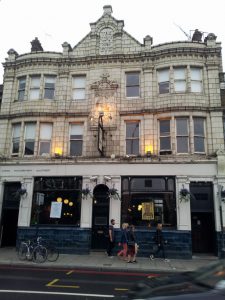
What’s that awful ‘photo got to do with anything?  Well, yesterday was my first non-clinical birthday. That’s to say, on the 27th of July a year ago in 2016 I was in that building scrambling to finish my final work in the NHS and my final work as a clinician.  I didn’t quite get everything done and had to offload making sure a couple of letters went off to a kindly trainee psychiatrist but, looking back on it, rather remarkably, everything else was done and I crossed the road from that small psychotherapy unit in which I had been working to the pub directly opposite for my leaving do.

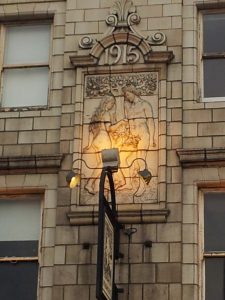
That’s the rather lovely Adam & Eve pub, a picture I took a year before during the pub’s 100th birthday year.  Look at this for an glorious piece of decorative glazed brickwork.  I wonder how being in the first or second year of “the great war” affected building something like that?

Enough of that, well, not quite.  It was a lovely pub and had the unusual distinction of having an L-shaped pool table.  I was a bit overfaced by the evening which was had a mixed sample of my fellow staff from the Trust: a good number of psychiatrists in training and a good number of older colleagues, mostly but not all from that little building across the road.  I think I’ve always found myself two not completely miscible groups of friends, acquaintances, peers, colleagues throughout my life.  Hm, topic for a post there some time thinking on how true that has been.

Anyway, where has the year gone?  Where has it got me?  Where have I got myself?  Do I miss clinical work?  What have I achieved?

Aye, there’s the rub! But interesting questions.  Well of course, the year seems to have raced by.  It started with the cycle ride, my pilgrimage, that created this blog/site and it’s been hard for anything to compete with the pleasures, and the challenges, of that.  However, I’ve seen some fantastic theatre and exhibitions.  I’ve had great work trips to Portugal, Albania, Italy and Spain.  I’ve had great family holiday trips to Glasgow, the French Alps and to Lefkada (Greece). I’ve done some teaching of various sorts in Roehampton to some great students, and some of that went satisfyingly well and some of it was OK but good in helping see things to improve.  I have done a lot of number crunching and I’m a lot more familiar with R (https://www.r-project.org/) and a few of my methodological ideas have developed a bit.  However, I’ve got very few papers out, only one so far in fact (Psychometric Properties of the Finnish Version of the Young Person’s Clinical Outcomes in Routine Evaluation (YP-CORE) Questionnaire). Last year wasn’t great for paper output either and I’m aware of feeling quite unproductive and frustrated with that.

My intention was to make more time for pleasure: art, theatre and reading and for exercise and I’m probably about halfway to the increased hours in the week that I was hoping to have for those things and I know that can be changed.  I wanted to be able to cycle pretty much everywhere I needed to within London and I really have done that.  I guess I’m not quite where I wanted to be but it’s not bad really.  So why do I feel so unproductive and dissatisfied with that?

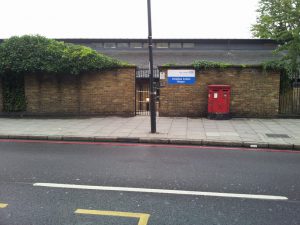
The last few weeks as I became aware that the year was nearly up I have wondered more about missing clinical work and I had a short run of nightmares or horrible dreams all of which were about me being in some sort of clinical situation or other and failing to do all things that were necessary and getting sickly scared of what would happen.  Some were definitely psychiatric in setting but the focus was on physical health things I should have been doing and some had me back in pure physical health settings I hadn’t been in for 32 years.  I’ve thought a little bit more about ex-colleagues (not the ones I keep in touch with, they’re always floating around my mind!).  I’ve wondered about getting back in touch with some people but so far it’s felt wrong, I’m not sure why.  I’ve thought a bit more about ex-clients and that’s surprisingly often about the same really very small percentage of them and almost entirely either about poeple I saw very early in my career or ones I saw in my last job (behind that inauspicious gate onto Homerton High Street).  I remain completely convinced that I made the right decision to stop and also intrigued by how little I’ve overtly missed the rôle and the work.  However, I think some of the dissatisfaction with my productivity is because it’s so hard to replace that you were really pretty important to people: to colleagues as well as to clients.  That’s a funny one to digest.  I think I was careful not to let that get out of hand or be too important to me but it undoubtedly patches thin bits and frank holes in your confidence to find that you matter.  One year on I can feel that I do miss that, that it has given me some work to do on those exposed holes and fraying threads in my ego.  The challenge is to work on them by things other than just working hard and trying to output a lot.  Work in progress!  Starting next week, on the 2nd, the anniversary of that grey, damp morning that I pointed a well laden Toto off towards Compostella, I intend to review each of those days and to see if I can upload more things here and blog each day, mostly reliving the pleasures and challenges, but also using it to help the movement on.

Fun ahead I hope!


Hoping for a new political climate and new priorities

It’s a funny thing trying to write a blog.  I was never any good at keeping a diary despite trying several times in my adolescence and young adulthood.  I started this back in August last year, very excited, and a little bit fearful, both at the change of giving up clinical work and at the attempt to cycle to Compostella and Finisterre.  Then it was much more a technological challenge than a psychological one to get posts out.  Now, it’s a psychological challenge and there’s something, having passed 60, about a much more general reflection on, and reshaping of, my relationship with the world.

In my last post I noted, a bit slyly, that we have had a momentous general election here.  I read someone, a journalist, saying that a colleague of his in Albania (it was actually Kosovo I suspect), reporting an election there, commented that the British were odd: how come the winners of our election looked so glum and the losers so happy?  Good point.  Well, as a lifelong socialist (whatever that means), the result was the best I’d allowed myself to hope might happen, even though it left the Conservatives in power.  In the event, with whatever the deal is that they have struck with the DUP, it’s perhaps simultaneously even better than I’d allowed myself to hope for, and a bit worse.  The “worse” bit, for those outside the UK, is that there’s very little (anything?) in the DUP’s manifesto and political position with which I can have any sympathy, so perhaps this will be grim.  However, it feels hard to see it lasting very long or enacting that much that is worse than May would have done without the DUP so I am trying to stay happy and hopeful.

However, this week there is a real and gross hurt in London and, I suspect, most of the UK.  The Grenfell tower fire has come hard on the heels of the London Bridge/Borough Market atrocity.  A week ago I found myself cycling past the wall covered with post it notes and overlooking hundreds and hundreds of bouquets of flowers at London Bridge. I’d just been to a truly glorious photography exhibition and had a lovely end of exhibition experience meeting the curator and the director of a brilliant film that had been part of the show. (Another post about that soon I hope.) Cycling along slowly, in beautiful sunshine, glowing inwardly from that good experience, I had almost forgetten where my route would take me and it was sobering to see the wall and the carpet of flowers, and I was immediately aware that not so many weeks ago I’d been cycling over Westminster Bridge a few days after the atrocity there.  Suddenly, human hatred, and the lost lives, blighted survivors’ and relatives’ and friends’ lives all felt so horrifically palpable.

Each time these horrors have hit London, one of my overseas friends and colleagues has Emailed me asking if I and my family are OK and each time I’ve been deeply touched.  Westminster and London Bridge both happened while I was out of London and that added an odd distance to the news, a dissociated feeling.

Now we have Grenfell tower and so, so many more deaths and I woke up on Wednesday in South London immediately thinking that I must have seen the tower many times though it’s an area of London, unlike Westminster & London Bridges, that I don’t know very well.  I don’t know why but this particular horror seemed to hit me hard and I felt pretty shaken all Wednesday.

Last night J and I met up with two younger friends, an ex-colleague from my last clinical job, and his wife.  We had been to the Tate Modern, very near London Bridge, it was nearing 23.00 and suddenly there were enormous bangs but no visible flashes in the sky from where we were.  A year or so ago we’d all have just thought “wonder what those fireworks are about?” but last night was very different and I immediately thought, though my medical competence is probably about that of a member of the general public who did a first aid course, that I should perhaps move in the direction of the noise.  It was hard to locate and J clearly felt I should move too, and Hugh I think felt the same (he’s a much younger and still GMC registered psychiatrist and probably a lot of real help in a mess).  So and I walked awkwardly, a bit faster than sauntering but embarrassed perhaps to move really fast.  We headed to the river to get a view of the sky, increasingly aware that realistically the continuation of the noise meant it had to be fireworks but somehow still unable to relax, I could even now see a small bit of smoke but still no flashes of light.  Suddenly we could see them and the relief was huge.

While we were (until then) having a lovely time, we learned later that earlier in the day people had been protesting about Grenfell tower and not just in the borough but outside BBC headquarters and Downing Street.  That’s the key thought driving this post: surely we in the UK are on the swing of the pendulum?  Surely a new political climate might emerge from this that could be about valuing lives, valuing people, finding bonds, not putting wealth and achievement above gentleness, generosity and empathy for everyone?

It really feels as if we are on that swing here.  Now how to help that be a really good and sustainable change away from greed and contempt driven discourses?  Of course I don’t know, sure but perhaps nailing my longing to a little blog is a useful bit of movement, at least for me.  I’ve realised over the last year that the grotesque excesses of “free market” worshipping capitalism, and the hatred and contempt for other people that I think is one of its covert drivers, has to be fought.  I’ve realised that I was quiet and polite for too long and that many of us being that way helped it grow and grow.

However, the fight mustn’t just be about anger but also about positives.  Knowing that I have come to know an extremely diverse group of people, worked with so many remarkable people, mostly in the UK but really all over the world too, people who believe in helping other people; that’s been an incredible gift.  It meant that when a tower block fire in London was seen in Shanghai, I got an Email from there and that I’ve gone on to discover that my friend there lost friends in a similar fire there some years ago and that, of course, that still matters to her.  Having these connections, locally, with people I can meet, and nearly half the world away, is a privilege but in our global world, with Email & so many audio & video chat options, perhaps such webs of connectedness are ones we can all have.  I believe we’re a species always longing for people who empathise and care, on good days, I think we’re a species that really can try not to let hurt and sorrow turn to hate.  These days are ones for action  and change though, not stasis and complicity.

Just a short post to reassure myself I still can: robins

I have been very silent here for too long.  Good and interesting things happen to me, horrible things happen to others and shock me, I work hard but also have some fun, however, I don’t make time to put anything new here.  Not sure why not and my electronic social communicating has reduced to a trickle too.  Something is going on.

Well, time for a change and I have made one resolution: that posts are best when they’re contemporaneous, but feeling that must be contemporaneous is not true or helpful.  To celebrate that decision: this one is really about the last four or five days and mostly just about simple pleasures.

I’m pretty committed to feeding the birds in our little, walled in, back garden in South London and one huge pleasure now is seeing the young birds arrive.  About a week ago there were some very fluffy, dishevelled looking blue tits on the nearest feeder to the kitchen window who were clearly still not completely rid of all their fledgling, fluffy feathers but who were already adept at using the feeder.  By contrast the robins were really funny.  The two seemingly fully fledged young ones had no fluff at all, slightly shorter tails I think than they will have, and that lovely year one plumage robins have then.  They could fly well but their approach to feeding certainly wasn’t to do any hard work on the feeders.  They just sat on a stack of wood left from our fence being replaced and every minute or so they would flutter their wings violently, like an avian sit up comics doing a take off of a humming bird, and they would open they beaks to create great quadrilateral voids and they would cheep, loudly to parent robin ears I’m sure though hardly audible through double glazing and my ageing ears.  It worked as of course it must and must have done for thousands and thousands of generations of robins.  The parents went zipping back and forth between the feeders and the young uns and in my fantasy those young uns got visibly fatter by the minute and the parents visibly thinner.

Why the different models?  Why are the blue tits up and at the feeding business before having completely lost their baby down while the robins look perfectly sleek and fly busily but rely on the parents’ and their own conditioning to get the hard work done for them for a few more days?

Fascinating.  The last two days all the blue tits I’ve seen have been fluff free and I’m not catching the young robins hitting the genetic programming to get fed.  Finally I have even seen the first of the young robins on the feeder without parental assistance.  Things move on apace.  Oh, and in case you haven’t been reading these things, we in the UK have a new government … and some reasons to celebrate and to hope that we don’t have to be in thrall to the right wing tabloids and relentlessly capitalist political answers from all parties for ever.  Now how do we build on the landslide that still leaves us with a surreal tory/DUP collaboration?  Not by whingeing anyway: onward Christopher!

Much to celebrate. Now I really must work!

Canaries, clean air and freedom

Created 3/5/17

Well, it’s been a long time since I last posted anything here.  Somehow, my life has been very busy and I’ve felt a bit persecuted by some big lumps of work analysing CORE data other people have made available to me.  I’ve felt the pressure to get results to them and haven’t squeezed writing new posts here into the crowded timetable.  I think there’s also something about only being able to stick my head up here when I’m in the right mood. Somehow, it’s much easier to feel in that mood when travelling, which I am again now (the Netherlands, work!)  However, that’s not the subject of this post.  The canaries are from last week.

It started last Wednesday, the 26th of April when I found myself putting in the London cycling miles.  Early afternoon I was in Roehampton for a meeting.  I got home from that and fairly soon set out again for UCL (University College London) for a “Rally for Academic Freedom” organised by SSEES, the School of Slavonic and Eastern European Studies (http://www.ucl.ac.uk/ssees/).  Declaration of interest and, sadly, explanation of how I knew about the rally: SSEES runs the Russian Studies course my daughter is on, but she, daughter, is in the third year of that and in Moscow at the moment so in some ways I went on her behalf.  They were hosting the rally to raise awareness of the threats to close two George Soros supported universities, one in Russia and one in Hungary.

I was glad I went but there were perhaps only 70 of us there on an unseasonably cold evening. That’s a very small number if we’re going to change things.  Fortunately people in Hungary have been out protesting in their tens of thousands.  Anyway, we stood in the quad at the heart of UCL, see https://en.wikipedia.org/wiki/UCL_Main_Building for some ‘photos of it in much nicer weather.  There were speeches conveying well the extent to which the ostensibly disconnected attacks on the two universities were political and about shutting down places fostering free thinking and free discussion.  One speaker described the farce of a recent conference in Budapest where political pressures insisted that Hungarians would only go to one part of the conference, where they would only hear carefully selected speakers who would not raise any questions Viktor Orbán’s friends would not want raised. Meanwhile a Hungarian, working at the Central European University in Budapest but with critical views, was only allowed to speak to the non-Hungarians.

So what about canaries?  Well, there were small but bright placards borne by fellow frostbitten audience and a number had one on an intense pink background I think saying “Universities are the canaries of democracy” (I think that was the line).  My first reaction was that canaries didn’t seem likely superheroes and I was feeling a real need for superheroes.  My first association was that the word can be used to describe a political informer (“stool pigeon” is another quaint English phrase, we don’t trust these birds do we?)  Then I got the reference: to the use of caged canaries in mines.  When the poor old canary dropped off its perch it was time to get the hell out of the mine as the air was dangerous (usually carbon monoxide).  I ought to get that reference to canaries: my paternal great-great-grandfather and great-grandfather both died in mine disasters (explosions or collapses I think, not CO poisoning) meaning that my father, and his late brother, were the first children for three generations to grow up knowing their father.

That canary idea really stuck with me.  My belief that universities should be vital places that detect early changes in our world, and offer places to discuss and evaluate all that’s happening around us, is why I’ve always been on the edges of the university world (and now, part-time, employed by one!)  The attacks on CEU in Budapest and on the Soros supported university in St. Petersburg (https://www.insidehighered.com/news/2017/03/30/hungary-and-russia-western-style-universities-are-under-threat) are clear and nasty, and it’s good that the EU (remember we’re still in the EU oh Brexit stool pigeons?) is coming to the defence of the CEU though how much Orbán will care who knows?

However, what struck me standing there while my toes sent alarm messages to my brain saying they wanted me to dress up more for these things in future, was sadness about universities in the UK alongside the anger about Hungary and Russia.  I listened and thought that the self-censorship that one speaker commented on in Hungary in the face of Orbán’s attacks wasn’t so different from that in academia in the UK.  It is different: what is happening in Hungary and the Russian Federation is driven by blatant bullying, by putting people’s jobs directly, and pretty much illegally, under threat.  That’s not the situation in the UK.  However, the situation here is that academics in my field will only get government funding to the types of research the government think should happen and people need that funding to keep academic jobs, so only brave, old or very angry academics raise their voices against that and many think hard before overtly criticising government.  A few do raise their voices but some of them seem to me to get easily corralled and used to show how open things are, but, subtly though powerfully, also to show how marginal these people are.  The same angry voices are used time and time again and often this seems to create shouting matches or Punch and Judy discourse, not real exploration and criticism.

The following evening I found myself in another academic setting.  This time a modern lecture theatre in Queen Mary University London on the old London Hospital site in East London.  I was there as part of MedFest (https://www.medfest2017.com/).  An audience of people from the general public interested in mental health and medical students came to see, on this occasion, four short films and to listen to five of us on the panel comment and, at the end, to join a discussion under the great title “Eros and Thanatos”.  The idea is to encourage medical students to think about taking up a career in psychiatry.  If it puts anyone off then I think they wouldn’t have been happy in, nor good at, psychiatry though I guess we can’t know if it really works.

However, I ended the evening, cheekily grabbing the last minute or so of the discussion, to tell the story of the canaries of the mines and of democracy and the dangers in Hungary and Russia, but also to say, genuinely, that the discussion had felt in exactly that great tradition in which UK universities host things that really do feel vital. As a panel we managed to disagree a fair but I think intelligently and respectfully, and we agreed about a lot.  The audience were the real stars though: interested throughout, concerned about the state of the world and how to find healthier lives, both physically and mentally, both for ourselves but also for our children and children’s children who will inherit a world we seem to be putting under continuing war and whose atmosphere, oceans and land we seem to be poisoning.  We found it hard to talk about Freud’s Thanatos, his idea that humans really do have an unconscious death wish, of course we found it hard: it is hard.  But it felt less fearfully fended off than even in many psychotherapy training organisations.  We didn’t have answers but there was warmth and solidarity in all wrestling with the issues and not pretending that any of us will live for ever.

And yes, in case anyone thinks by clean air I’m not just talking about the vital clean air of critical, politically critical thinking and discussion but also of clean air to breath: yes, I think that’d be good too!  Cycling in the wrong bits of London at the wrong times of day may not be as bad as in places in China say, but my local high street, Brixton High Street (OK, it’s a mile or so from home which stretches “local” a bit) used up it’s air pollution allowance for the year in the first week of 2017.  That’s my route to pretty much all central London.  Yes, let’s really get things changing and let’s keep CEU and other threatened universities alive, and let’s make UK universities and society braver to question our politicians, media controllers and, frankly, the way we all let things run.

Superbowl

Yes, I admit it, I watched it!  I started watching American Football back in 1986 I think.  Around that time I and a former partner, and still good friend, watched bits of three rather odd international sports: American Football, Australian Rules Football and Sumo.  We both worked hard with full time jobs and more on top.  My partner had psychotherapy training activities and I was doing research work that would take me way beyond 40 hours a week.  As a result I think we liked the sense we could collapse in front of the TV and watch things which were engrossing, clearly foci of absolutely passionate devotion to their local followers, but really very alien for us.  Neither of us were particularly sports players or sports watchers, though I would watch what was then the five nations rugby at least if Wales were playing.

Those were days before domestic internet or satellite TV and I think we had four terrestrial TV channels.  I’m pretty sure we got all three sports courtesy of “Channel 4” which was quite interestingly experimental then.  The Aussie rules stopped quite soon I think and the combination of, as I remember it, an oval pitch, inner rugby posts with lateral additional posts, and officials in lab coats and white fedoras on the goals was bizarre and interesting.  The sumo lasted a bit longer but again Channel 4 stopped covering it (as I remember it now).  Again, the shinto elements and huge thread of genuinely old ritual, with the brute physicality but also huge nibbleness of the vast men, and all the psychology were fascinating and I felt that both Aussie rules and sumo said much about the cultures of Australia and Japan.

The one that survived was American Football, initially on Channel 4 and then moving around, now on BBC.  I stopped watching regularly after a year or two as my life got more busy (and I think the coverage perhaps stopped or thinned out heavily for a while) but most years the superbowl was broadcast to the UK and for quite a few years back then I would watch it live.  I went through more than a decade when I didn’t watch at all but took up again perhaps 10 years back, though only the superbowl each year as a sort of bizarre orgy of some beers and a strange solitary experience (J has zero interest in sport on TV: exposed to too much in her childhood she pleads).

It is solitary for me here in the UK but in another way it’s not: there’s a particularly chatty format to the US commentary on games, with two old wisecrackers swapping thoughts, reminiscences and gossip about the game and of course there are the reminders of a few (thousands) of people who have turned up to watch live often with placards and strange garb.  One is never truly alone watching NFL games I think!  Over the last few years first ITV (one of our terrestrial commercial channels) and now BBC have also created two very British commentary teams.  When it stopped I missed the duo ITV used, a Brit and a UK resident American expert: Gary Imlach and Mike Carlson and was sceptical about the trio of Mark Chapman (Brit, not an American footballer) with Jason Bell (US, ex-player) and Osi Umenyiora (British nationality(?) ex-superbowl winner twice) but they have become a wonderful, sometimes extremely funny, commentary team.

Anyway, I confess that I did stay up until 04.00 Sunday night.  I watch partly because it is a simply amazing spectacle and shows superhuman athletes playing a fantastically complex team game demanding not only incredible athletic skills of many sorts, but also enormous game intelligence to remember the huge team playbooks and the Byzantine rules.  However, I also watch because it can be enormously exciting but I know I watch partly because it gives me an insight into the USA.

And I need those just now!  One thing that intrigues me is that the US seems in some way so much in favour of a neocon interpretation of free trade and to have a deep mistrust of any levelling of the playing field by, for example, state funded health care making things better for those who are ill or disabled.  However, its NFL is built around very carefully structured rules that try to rebalance things so the team with the worst record at the end of the season gets the first “draft pick” of new players coming available and the superbowl winner and loser get the last and second last pick respectively.  Now that seems much better to me than the nakedly capitalist trading of players in football (at least in the UK) and in the cricket in the Indian Premier League where it seems that money wins with no re-levelling built in.  I think that does speak to a very different thread of thought and emotion in US culture. How can that be encouraged and the horrifying glorification of spending (half-time show adverts anyone?) and hyper-wealth discouraged, particularly in its effect on US political campaigning?

Talking of the half-time show, I’m not really a Lady Gaga enthusiast but hooray for her for giving us part of Woody Guthrie’s anthem for collective commons “This land is your land“, I think Bruce Sprinsteen does it better than Lady Gaga but I am glad made her statement.

Last Monday night: another protest and it goes on

It’s Friday evening now and I’m tired but I feel a real wish, a need, to put this up here.

Monday (30/1/17) I worked from home.  I took an hour out to do the annual RSPB “Great Garden Birdwatch”, more on that over the weekend I hope.  Even without that, as the day drew on I had the familiar feeling that I had achieved less than I had hoped, less than I had planned to, arguably less than I needed to.  However, as the day wore on I learned that there was another protest in London, again against Trump, this time against his “Moslem ban”, his executive order barring entry to the US of anyone born in or having nationality of the now famous seven countries, all predominantly Moslem countries by religion.  (I’ll come back to being pedantically, meticulously, precise later.)

The protest was to be at 18.00 in Whitehall, the big road Downing Street joins, and as near as one can get to our Prime Minister as a member of the protesting public.  I knew I had to go.

So Toto and I set off for Whitehall.  Coming over Westminster Bridge the stream of people was thickening and the traffic diversions were in place so I locked Toto up safely and made my way toward the junction of Whitehall and Downing Street.  It was a longer way than it might have been as one of the cut throughs I would have used was blocked by a friendly policeman explaining to us that that was just for people working in that government building.  The crowd was thick where I did manage to join Whitehall and it was clear that, as with the Women’s march, police had underestimated the numbers and the speed with we would stifle Whitehall.  Cars, buses and delivery vans were trapped.  I was impressed by how friendly and tolerant their denizens were being: the bus passengers were decanted I think, and sent on their ways by foot to find new buses beyond the masses, and the others were simply trapped.

Can I do this?  Can I put a link to the Sun, that disgusting pretence of a newspaper?  Oh joy, I will, I can, because google lobbed it to me and the picture at the top gives a good sense of the numbers and the trapped bus.  Even the Sun can recycle truths sometimes I guess.

I don’t know how many protesters were there and I never got near enough to the entrance to Downing Street to hear speeches.  I heard one person coming back through the crowds say they were good — when it had been possible to hear them over the cheers and chants.  This protest did, I think, have a clear leader: Owen Jones, an emerging young critic of our political messes.  It had its organiser, it had its speakers and, vitally, it had its many of us.  I must have seen over a thousand people as I let myself sift through parts of it, and as waves of people streamed past me slowly in different directions. I must have made quick eye contact with hundreds and probably read a hundred banners or more. The protest filled Whitehall, which is an ample dual carriageway width road and it was solid way back toward Trafalgar Square so the numbers must have been many thousands over the course of the evening. I never had a viewpoint to have a chance of even a rough estimate and it would be hard one to call I suspect as, when I decided to head home at 19.30, hordes of new people were streaming in still.

As in the women’s march the membership was diverse.  One very respectable man in what I’d call “senior civil servant” suit and very good overcoat, good hat and umbrella had no banner but was there with young child (2-3 years?) in pushchair, or sometimes on the tall man’s shoulders, and he was with the equally well dressed and respectable looking wife.  As at the women’s march, not your “usual protesters”. There were a very small group of “usual protestors” behind me for a bit, whose conversation seemed to me to be about them, well, mostly one young man, about his pleasure that he was against everything.  I can be intolerant and they seemed to me to be missing the point.  Oh boy were they the minority.  There were people of all ages, many very young and none of them seeming intimidated or fearful.  Many significantly older than me.  There was at least one expectant bump labelled with a sign telling us s/he was there in spirit and would be out and swelling the numbers in some months.  There were all colours of course (this is London and hooray for multicultural London), there were many, many with US accents and my US accent location isn’t that great but sufficiently good that I think I can say many States were represented.  Again there were the personal banners, many clearly improvised at the last minute from pieces of cardboard avaiable at home or work.  They were mostly amusing, often beautifully so.  Two men near me had a neat one improvised from an umbrella with a small bike light on the handle of the umbrella providing its own floodlight to their sign.  I confess I can picture the umbrella and the light now but I’ve completely forgotten the wording though I remember agreeing with it!

As I finally decided it was time to get home and, very, very slowly, joined a flow of us doing that, meeting a much larger flow coming in, I passed two particularly eye catching signs with their people (you know how it is in some demonstrations, like some dogs walking their people in more sparsely peopled settings).  One said (I paraphrase) “Child of Jewish refugees to the UK who fled from the Nazis welcomes Moslem refugees here” with a single woman (when I saw it and her) about my age but in better looking nick than me, standing by it and smiling warmly,  clearly as glad to be part of all this as I was and we shared a quick warm smile to each other.  Another, larger one, with a bunch of people said “Jews from xxx welcome all Moslems in the UK” (I’ve forgotten where “xxx” was). This was a mixed group in age and gender with calm demeanours and radiating that sentiment … as did so many others.

The chants came and went “Shame on May” and “Shout it loud, shout it clear, refugees are welcome here”.  I could smile assent but I’m not a chanter, it may be cowardly but I fear some of that sense of moving with and into a mob. I fear its nearness to what Trump and others use to rise to power.   That brings me to another issue for me, and to how I come to be writing this tonight.

I’ve been meaning to write something about the protest ever since Monday but needed to start with the post about the women’s march, and having done that, well, it’s been a busy work week.  As I said, I was tired when I got home tonight but I knuckled down to work some more (J won’t be home from her work day until 11.30!) I found myself looking at the Lancet and there was an article “Free speech and facts in the Trump era”.  It’s very short, it’s free to open so do click on this link: http://linkinghub.elsevier.com/retrieve/pii/S0140673617302659  and read what that eminent journal’s editors are saying, and their stress on the need to hold to facts and everyone’s gains and losses, not just on the short term gains Trump promises to the already hugely priviledged.

So how does that link with my reluctance to join chants, and in turn with my interest in facts?  Well, at the moment I’m trying to understand why 19.8% of US citizens voted for this man.  Oh, you’re not sure about that 19.8%?  Well, it was 62,985,105 votes if we sidestep for the moment some questions about how many of those may have been fraudulent.  The estimated population of the USA on 23/1/17, from a quick hunt on the web, was 324,420,000 so he won on a landslide popular vote of just under a fifth of the population.  Let’s also remember that it was only 96% of the votes Hilary Cinton got (65,853,625), though, as we all know, Trump claims that at least 2,868,521 of her votes were fraudulent, well, let’s quote him “In addition to winning the Electoral College in a landslide, I won the popular vote if you deduct the millions of people who voted illegally” (https://twitter.com/realDonaldTrump/status/802972944532209664?ref_src=twsrc%5Etfw)  OK, I’m trying to hold onto the fact that by my calculations 255,914,895 upstanding US citizens, well, probably many prone or supine US citizens didn’t vote for him.  OK, OK, many of them were prisoners and homeless without a vote, many were under voting age, I’ve located that 19.8% of the US population were under 14 so I’m guessing we can exclude them.  That still leaves us with a lot of people who could have voted in principle and didn’t vote for Trump.  We mustn’t start blaming all US citizens but I really want to understand why 62,985,105 voted for him and why so many didn’t vote against him.

I think I understand something about why some of the 62,985,105 voted for him and I think it’s partly that he’s a chanter and some of those 62,985,105 wanted to rally behind an angry chanter.  That’s what his often fact free rhetoric is: modern chanting.  I’m not knocking the chanters at the protest, I don’t think the chants were in the same arena of content free rhythm: “Shame on May!” – Yes!  I think Theresa May should be ashamed, that all of us there wanted to say that we think she brings shame on the UK.  This wasn’t idiot chanting.  “… refugees are welcome here”: yes again.  We’re an overcrowded island but people shouldn’t be drowning in their hundreds already in the Mediterranean this year alone, people fleeing persecution in other countries should be welcomed here.  We all at that protest believe that.  I don’t think anyone there believes that’s a simple stance to take nor that it’s without risks.  Of course welcoming refugees opens one way for spies or bombers to get into a country but blocking all refugees is unlikely to prevent all murderously angry people from killing (was Timothy McVeigh an immigrant?)

So I agreed with the chants and they weren’t fact free.  However, going along with chanting overlaps with being sucked into the rhythms and rage of tyrants.  One thing that chills me about Trump, and quite a few other rising right wing figures, is their disdain for fact and the way this manipulation is masked by the crudest use of rhythm and repetition.  As an 18 year old at university for the first time I got to see most of Leni Riefenstal’s films including the famous “Triumph of the will” about Hitler’s 1934 Nazi propagand rallies in Nuremberg.  There are horrible facts about her awe of Hitler but she left a record for us and I think if you watch that you see the relentless, spitting, inarticulate speech patterns that foster a chanting, unifying, sickening collapse among the listeners and you see how many independent, diverse people get transformed into an organisable mob, and then into a wave of terror. I don’t speak German (for shame, three feeble attempts to learn some all failed) but you can hear that the content he is firing at the microphones is not really the message, that there doesn’t have to be any reality base to the content.  I know that native German speakers have analysed his speeches and comment on the reduced vocabulary, the minimal and, I believe, often (deliberately?) poor grammar.  What Hitler and others were using was a disdain for truth, a strategic use of “alternative facts” and a chanting seduction.  Trump is not Hitler, his nationalism seems much more about elevating a few than creating a new Nazi party, but there are chilling similarities in form, in the blaming of “others”, in the hatred, and in the complete disdain for truths.

So let’s fight in all the ways we can but with meticulous facts where we can: yes 62,985,105 voted for him, but it was under 20% of the population, it was fewer than voted for Clinton. As the Lancet says, we need to hold onto facts and back them up, protect them against attack and replacement with “alternative facts”.  We also need all our generosity: the protesting bump, the warmth of that child of refugee Jews fleeing Nazism, the love of diversity and the willingness to work at all that is hard about bridging difference to live with each other.  Enough for one night though.