Life at 2000m: settling in

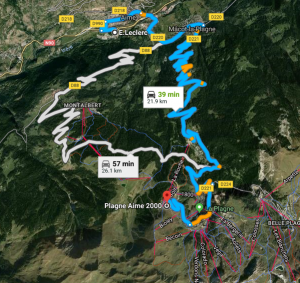
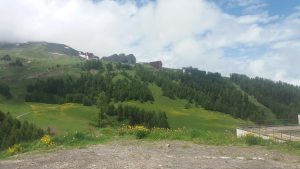
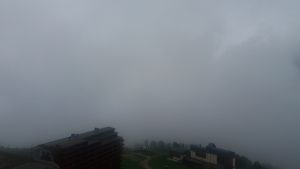
Well it’s Thursday (14th July 2018 for the record) and I arrived up here on Monday.  Time for an assessment of things.  This was my first sight of Aime2000 from the taxi (50 Euros, though a lovely driver!) coming up from Aime.

(I am working on how to insert ‘photos of various sizes here: I will improve on this but no joy so far.)

I hope you can see something there and you’re probably wondering why such an obviously awful shot is doing here.  Well that zigzag slightly left of centre on the skyline is Aime2000.

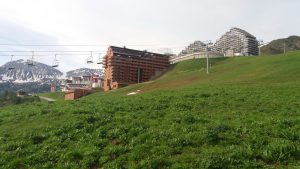
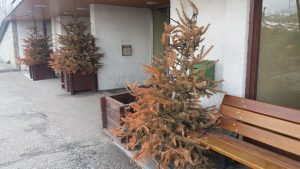
That’s blown it up a bit.  I hope you agree it’s an iconic silhouette!  The driver dropped me off at the main entrance where we found these sad remnants from the skiing season, well, clearly from the Christmas end of the skiing season.  I think he was a bit worried that I might find the place a ghost time with everything as dead as those trees and I confess I was slightly rattled.  However, the first set of lifts were working and I and all my luggage were soon up from that level to the G deck that runs the full length of the enormous building.  Everything was silent and the usual lifts up from there to our level (L) weren’t working but I realised that they wouldn’t be, only the goods lift would be … and fortunately it was.  Lugging that lot up five floors would have been lethal.

So I made good use of that life up and down to the “cave” (cellar, actually just level D where we have a storage cupboard for our things to hide in when we’re subletting the appartment) and I moved what I needed from there and unpacked my luggage.

Whoops, rather an embarrassing ratio of alcohol and alcohol related things from the cave to the perishables I’d brought up from the valley!

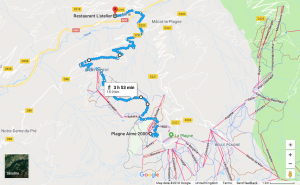
I headed out to find the local Spar supermarket.  Closed.  Oops. Google maps assured me that the one another mile or so on and a few more hundred metres back up to on a level with Aime2000 would be open.  No. Actually it closed in April at the end of the ski season apparently and won’t open I think until the next ski season starts just before Christmas.  Oops, suddenly that fridge wasn’t looking so funny.  I legged it back down to the first Spar … aha, big relief, it opens at 16.30 until 19.30 (and 07.30 to 12.30).

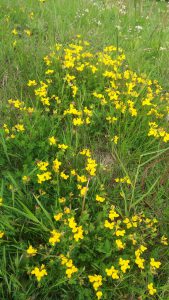
On that first round trip everything was green but speckled with yellow patches.

Bird life included a full house I think of swifts (common or alpine?), swallows, house and sand martins (or are they crag martins?), wagtails, larks, goldfinches, choughs and something with a blue flash a bit bigger than a thrush that was keeping well away from me.  Hm, my continental/French ornithology is very rusty and must remember to take my binoculars even if going to Spar.

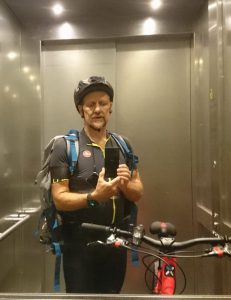
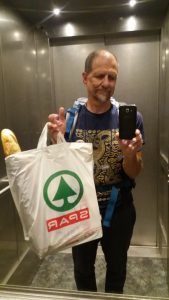
Me in the first lift with edibles (that backpack is full to the top!).

What was striking walking around was how much snow was still here from Easter and the ski season. This is meltwater pouring out of one of the conduits below Plagne Centre.  Yes the grey below me is the pebbly mess at the edge of the road by my feet but that dark mass is unmelted snow covered with grot.  That’s one of the places where the vital local snowploughs dump snow off the road in the snow season and you can see that it takes a lot of dirt and grot with it and as the huge mass of snow melts slowly as things warm up it looks like that.  A whole new experience for me: loads of black snow!

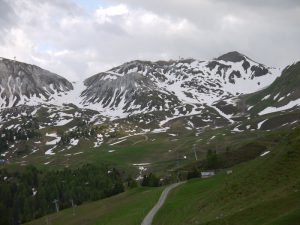
Here’s a more beautiful view from a bit further back up the road between Aime2000 and Plagne Centre (and the Spar that does open!)

You can just make out something on the rock ridge to the left that is the top of the telecabine lift up there and there are some visible constructions  on the relatively gently rising ridge to the right that are the top ends of ski lifts.  It looks to me as if there’s enough snow left in the red run that comes down the saddle between the two ridges for me to leg it up there with my skis and have probably 800m of run. It looks as if the top bits of the black run to right below those right hand constructions is also still thick with snow.

I’m sure the snow surface is completely impossible for skiing now but it looks as if its sufficient snow that might be hard to walk without snow shoes. Maybe some time next week I’ll dig mine out from the cave, sling them on my back and go up there to find out.  Not sure how far up there I’ll be able to get on the mountain bike so it’s a good few hours hike without wheels … but the bike is a story for tomorrow.

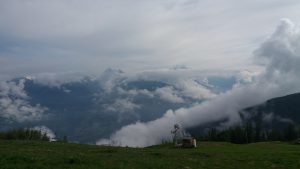
From that evening and about 30 minutes ago (18.15ish for the record) the clouds settled in.

In fact, for most of the last 48 hours not even that building below me was visible.

Why 18.15?  Because that’s when, writing this, I looked up and saw that Mont Blanc had finally become visible: the first time in four days.  I think that’s the longest I’ve ever been up here without being able to see it/him/her.  However, partly as I must get back to work and not go through the rigmarole involved in getting pictures off camera and ‘phone and up to the site.  A proper celebration of Mont Blanc here is for another day.  Meanwhile, I go back to work and continue acclimatising.


The semigration has finally started: transition

Today (Tuesday 12th of June 2018!) I woke up at 2000m and it seems about time I got another post up here to mark the event, it’s been a long time coming.

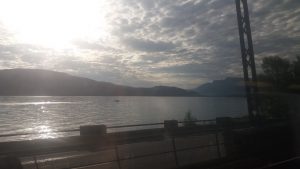
I arrived up here yesterday having had a lovely send off from J & S in St. Pancras before boarding the chunnel train for Paris. That went OK though I realised that I had really loaded myself up.  Things started to go a bit off piste with the transition from Paris Gare de Nord to Paris Gare de Lyon. Getting off the train was slow owning to the sheer pressure of people and all our luggage and although the connection only involves one intermediate stop, the train took for ever to come and I missed my booked departure by about five minutes.  SNCF were relentless despite it having been frankly impossible to have made the transition any quicker and hence, in my view, their booking error: it had to be a new ticket (ouch) and a three hour delay for the next train and a bus instead of a train for the last stage from Chambery to Aime. Their Email says that was down to meteorology and certainly neighbouring parts of France were having horrific storms with sufficient rain falling in an hour or so to cause severe flooding.  For amusement, here’s are some ‘photos which hardly convey the beauty of the Lac de Bourget that we shot past shortly before Chambery.

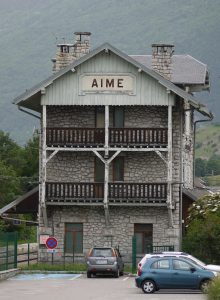
And here is quintessentially French railway architecture of the station in Aime.

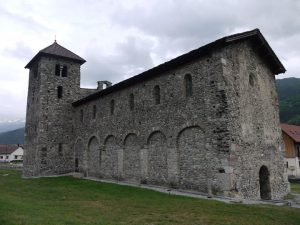
I opted to stay the night in Aime which is the main village/town of the commune and over a 1000m below my destination.  The next morning I decided to stay two nights when I discovered that Decathlon, which I wanted to visit to get a pushbike for my stay here, is closed on Sundays.  So I stayed two nights in the lovely Hotel Palanbo.  J and I stayed there for a few nights back in summer 2003 when we made a flying (actually, driving) visit here and put the offer on the appartment I’m in now.  Lovely little hotel with wonderfully friendly and relaxed staff, great simple breakfast and excellent wifi/internet! Sunday was greyish with the sun mostly struggling to get through low cloud but, as well as trying to get as much done with the internet while I had it, I had time to find Decathlon but more aesthetically, to revisit the wonderful basilica church and the Tour Montmayeur: a 15th C defensive tower.

That’s the Tour Montmayeur poking up above the surrounding houses and now, a rather grey skip around the lovely basilica.

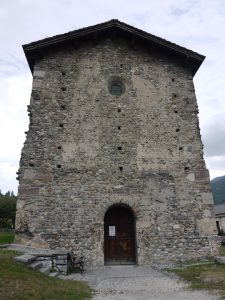
That’s approach to the west end also showing how much snow there is still on the high slopes.  That view shows that the priorities for the basilica were that it be defensible as well as a place of worship: not a lot of window or door as a proportion of the wall area.

Moving to my left, here’s the north face of the nave.  It’s called a basilica but I think the structure is a hybrid between simple basilica form and the cruciform standard that was largely to replace that.  Does the name here refer to the architectural form or something else, something about the status of the church within the Catholic hierarchy of the area?  I’d do some sleuthing but I am now on 3/4G internet only and need to ration myself very strictly until I can get a landline in and broadband.

I’m pretty sure that those have always been blind arcades, not windows at ground level.  There was a black redstart clearly nesting in a niche in the tower. I’ve always had an affection from them as I seem to remember a childhood book, whose name I’m not sure of now, started with the child at it’s centre, falling and I think breaking his arm climbing in bombed ruins in London shortly after WWII trying to get closer to a black redstart.  I’d never heard of them when I read the book but resonated with the risk taking, or really with the ambition that drove it.

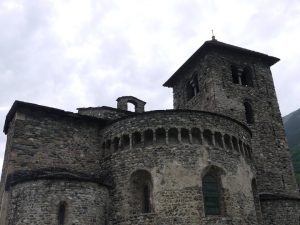
Here’s the beautiful (to my mind) East end with its apse and two little chapels.

I’m a sucker for this sort of simple architecture.  My guts say the apse was added at least a hundred years after the nave and tower.  My fingers are itching to go sleuthing but I must resist!

Detail high on the tower.

Simple but still so effective with the light recessing of both the whole window and the arches.

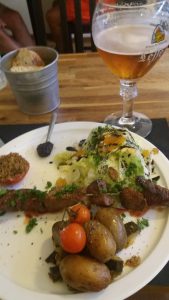
Sunday evening I found the Restaurant l’Atelier (hm, Google has it as “L’atelier”, I’m sure the French would capitalise it differently, again, must resist more sleuthing!)  Wonderful small restaurant, two friendly blokes have been running it for four years now and, though I like the usual Savoie/Tarentaise food with its typical peasant stress on calories and on locally available protein (here beef and cheese), this was different.

Up here yesterday and today I’m in a very different world.  It’s stunning to me how much snow simply hasn’t melted from the end of the ski season at Easter.  This was the most they’ve had here for 30 years.  If I were mad enough I think I could get my skis and ski boots out from the cave (storage cupboard in the basement) and walk up about another 800m and I think I could have hundreds of metres of one of the high red runs to myself.  I suspect that the surface of the snow is horrible and I’m not tempted but when I’ve got the bike I will cycle up there to look at it.  From here it looks as if pretty much everything up on the highest point in the domaine would be skiable.

When the sun’s out it’s lovely, when it’s not, it’s pretty cold still and this internet rationing is a challenge but I’m here and the hermitic life adaptation had started.  More on that in the next day or two, then back to more about Malta if I can find the Mbytes that’ll need!

Frames and cages (and Malta, part one)

I’m writing this in Luca airport in Malta at the end of a fascinating, but not always easy, week.  I arrived last Wednesday so it’s been eight days I’ve been here.  (Aapparently the colloquial phrase for a week in Maltese/Malti is “eight days” or something invoking “eight”).  I knew there would be two days of work, and there are always two more that are largely lost to the travelling. So I’d left myself four more to have some time to just be a sightseer.  That was four times what I usually allow myself on my work trips and not infrequently I don’t allow myself any rubbernecking time.  I guess that is the first cage I’m thinking about sitting here: normally I feel that I’m too far behind with things I’ve said I’ll do for/with various people to justify the extra time (and perhaps there’s something about any extra costs too).

Malta is an amazing place, and I hope this won’t people off visiting, but it’s been a mixed experience for me and at times I’ve felt caged here.  Some of that was about discovering that I wouldn’t realistically be able to mix much work the rubbernecking in those four days.  That came about through my location: I had pretty much caged myself without intending to!

I had booked myself into an airBnB to keep costs down.  That was a first for me and I think my inexperience both with airBnB, and with the geography and facilities of Malta didn’t help.  I booked into a lovely looking place in Zebbug. (There should be a dot on top of that “g” but my software currently doesn’t have that.  I think it’s pronounced “Zebbuj”, with the stress on the “bb”.)  Zebbug, , is near the middle of the main island, Malta itself, and looked sufficiently near to where I’d be working, Attard, that if need be I thought I could walk there.  I’ve just rechecked and it really is only 4km.  However, my colleague warned me the roads were not fun for walking (and she rated them lethal for anyone daft enough to hire a pushbike … and the death of a cyclist the first day I was here did seem to support that).

She was right about the walking, certainly if one took the main road.  I hadn’t really taken in what 37° heat, coupled, perhaps oddly, with quite high humidity (the island is small and the Mediterranean has a lot of warm water with which to nearly saturate the air) and high dust levels mean.  They don’t make attractive walking conditions for sure, particularly not if you should turn up looking like a moderately respectable academic asking for input on the CORE-OM translation with no pay for the volunteers!

In fact Marija gave me lifts to and from Mount Carmel Hospital both days we worked there so that was no problem.  Driving isn’t always easy on the island so it probably did help that I had chosen a place near the hospital and not far off her own direct route.

So I found myself feeling a bit caged not able to walk far, nor cycle.  However, there were other caged feelings.  Starting with this within minutes of getting up the first morning in the airBnB.

I know that’s a terrible ‘photo, shot on my ‘phone, through a window in the house, with the sun blasting down onto the plastic sheet above the cage but that really is two adult barn owls.  Inside, in the kitchen there was also a budgie in a pretty small cage, about a quarter of the size of the one that contained my grandparents’ budgie when I was a very young kid, some 60 years ago. Back then I suspect caged birds were more common in homes in the UK.  It’s funny how much the sight of two beautiful barn owls in a cage hit me.  It’s been one of those moments when I realise how deep some beliefs go in my psyche, somehow in my body too.

It was a couple of days later before I mentioned this to my host, who is a lovely man. He tells me he lets them fly free from the roof of the house and that they come back.  He has had them both from very young (weeks/months old) and both are under two years old.  I believe him completely and that shakes some of my convictions that they simply shouldn’t be caged, but it doesn’t remove those feelings.  I’m sure he doesn’t let the budgie fly free, my guts say that it wouldn’t return, but I have no logic for that.

So I found myself reflecting on just how central some ideas about freedom sit in my “core construct system”.  The idea of the “core construct system” is from Personal Construct Psychology (PCP) and is about those beliefs so central to who I am that they’re hard to change, sometimes hard even to notice.  For sure, this isn’t about something I haven’t noticed: the last few years for me have been a very conscious process of revolt against feeling caged by bureaucracies of one sort or another. Since leaving the NHS and the cycle ride that started this blog, I’ve spent a lot of time reflecting that my beliefs about allowing people to make their own decisions disabled me in the roles I’d come to occupy.  I’ve also been railing (reflecting doesn’t cover it!) about a culture that seems increasingly to trumpet about freedom while more and more restricting it, particularly for all but the wealthy or obscenely wealthy.

But back to last Thursday morning, those birds really hit me and ironically they sort of caged me.  The only place to work was a table downstairs near both the owls (in a light well behind a locked door from me) but near the budgie.  I desperately wanted to blog, and to do some work, but my room had a huge double bed with no real space for me to put the laptop on a surface and my legs under it.  I rapidly discovered that working with it on my lap, sitting on the bed was both uncomfortable after a while, and damn hot in an already very hot environment. Downstairs was the only option. However, I found I simply couldn’t stay down there: the not very strong, but inescapable smell of the birds, mostly of the budgie I’m sure, was nauseating to me.  I’m sure that was mainly some Pavlovian association of a disgust at their containment, with an admittedly not attractive, but not gross, smell.

The result is that this is my first blog post in a week in which I really hoped I’d do two or three and have had enough amazing sights and experiences, and felt connected to the reading I’d been doing about Malta, to have supported at least one post a day.  However, I couldn’t post from a laptop on my thighs, not when I’d used about 30 minutes in that position to do the main Email screening and quick replies that seem the minimum per day.

So here I am in Luca airport feeling released.  I fantasize that the feeling is the one those owls do when they spread their wings and fly above Zebbug.  I know that’s projective and crass anthropomorphism: who can know what the owls think or feel?   Clearly it can have little in common with my thinking about freedom.  Who am I too, to judge my host for his caged birds?  The frames that create meaning for us are always cultural and caged birds are common here.  I saw a good number of birds, all finches: chaffinches, bullfinches, goldfinches and greenfinches; being carried around in tiny cages, usually by men I would guess in the age range 45 to 70. At first I thought they were selling them but I think they were actually just taking them out for some freedom, of sorts.

The title here “Frames and cages” pays homage to Tony Ryle’s 1975 book “Frames and Cages: The Repertory Grid Approach to Human Understanding”.  Repertory grids, and personal construct theory, or personal construct psychology that I mentioned above, had a huge impact on me when I first discovered them, which would have been in 1980.  I met up with Tony, probably in 1986, and I did the analyses of grids that led to a paper with him (“Some meanings of body and self in eating-disordered and comparison subjects”) which came out in 1991.  I had the geeky skills to run the programme, INGRID, that was then hosted on the University of London mainframe, that crunched the grids, and the further geekiness to transfer the output to SPSS on the St. George’s Medical School minicomputer, to analyse the grids.  Maybe I should re-read the paper.  I’m not sure I’d like it but it was probably ahead the game back then.

Tony died, at 89, in 2016.  There are obituaries in the Guardian (https://www.theguardian.com/society/2016/nov/15/anthony-ryle-obituary, with a lovely ‘photo of him; sadly, I don’t think I have any of my own) and on the ACAT (Association for Cognitive Analytic Therapy, a therapy Tony pretty much created by melding some psychoanalytic ideas and PCP), https://www.acat.me.uk/page/tonys+biography  . I’m shocked to find that the obituaries in the British Medical Journal (at https://www.bmj.com/content/355/bmj.i6011.full) and even one on the ACAT site (https://www.acat.me.uk/reformulation.php?issue_id=52&article_id=502) are locked so that non-members can’t get to them.  I don’t think Tony would have approved of that, in fact, I’m pretty sure he’d agree with me that no self-respecting journal or membership organisation should be so desperate as to lock obituaries from public access.

There I go, railing about cages, paywalls and restrictions on freedom.  Hm, I think this theme is going to run and run here.  Enough for now.  For all there were challenges, I will post more about how much that is remarkable is here to see in Malta, and how much more that is almost unbelievable, is there in its history and prehistory.

GDPR compliance and a gull!

I’ve been getting “GDPR …”, “confirm you want …” and “Updating our privacy policy” Emails for weeks in a swelling tide and I’ve been amused to see them slowly getting, in my not so humble, barrack room lawyer opinion, on average more and more well judged about what GDPR really requires.  I do now wonder whether the organisations that are still asking us to confirm that we want to receive things are tacitly admitting that they don’t know if all the Email addresses they hold were obtained with full consent, or if some know damn well that not all of them were.

It’s been a good opportunity to cancel quite a lot of them.  Sometimes that’s had a tinge of sadness when my unsubscribing has been because the Emails were from London galleries and I have to face up to the fact that most of the things they are telling me they’re showing will come and go while I’m up in my mountain eyrie.  Still, it’s been good to purge most of them.

Finally though, I had to face up to whether the data I have here is GPDR compliant and, as I’m sure I don’t have personal information on anyone, other than some IP addresses that get collected in the hit logging, I didn’t think that would take much but of course it meant putting up a privacy policy, putting that in the top menu of the site. Then I realised that I didn’t have a “contact me” form so I added that too, and, in the end it has taken a while.  Still, as I was doing the necessarily rather more complicated GPDR compliance work for CORE, some of it was pretty familiar and easy.

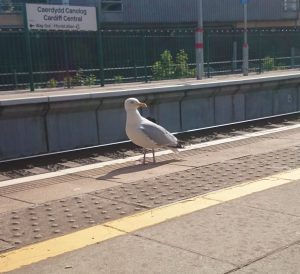
I guess I’m putting this here just to make anyone who follows this blog enough to have left comments or signed up for alerts pretty well 100% certain to have been given a pointer to the small print.  However, to illustrate things, I am adding a gull.

Now if you want, you can pull that jpeg file down, get the GPS data and work out exactly where s/he lives (if the sign in the background didn’t give it away anyway).  Do gulls have personal data protection rights?

And that brings me to link to a blog post that Emily, PhD student and much valued colleague in Roehampton has put up about GDPR. She has caught the anxiety she and so many researchers have been through over GDPR and how it impinged research data collection.  She’s also brought her usual gentle wit to things, much better than my feeble gulling!


A surreal Brexit/semigration experience

About ten days ago I found myself in an excellent short research meeting in Roehampton University (UR).  There were four of us in the room and we’d agreed to meet because we had overlapping interests in researching the positive and the negative perceptions and experiences many bereaved people have of the deceased person being still present: “Experiences of Continuing Presence” (ECP) and “Continuing Bonds” (CB).

The four of us were a lecturer in UR who is German by birth but has lived in the UK for many years and I’m sure her children have British nationality, or a right to it.   The next was a student from the University of Aarhus in Denmark near the end of her PhD.  The third was a PhD student doing his PhD in Roehampton but from Galicia in Spain originally (from just south of my beloved Santiago de Compostella) but who did a Masters degree at Leiden University after his Masters training in Clinical Psychology in Spain (and a short but important spell working in Bolivia).  I was the fourth there: the only native Brit and heading off to the Alps because Brexit threatens such a precious and wonderful mixing of minds, of cultural, spiritual/religious and linguistic experience and expertise.

Our second meeting a week later was augmented by a Brit who isn’t semigrating but who, like every Brit in the academic world I’ve talked to about my semigration, is hugely supportive of what I’m doing and, like every colleague and collaborator I have, is completely committed to working with me by Email, Zoom, Skype if it’ll ever work reliably, and whatever other tools we need to do distance collaboration.

It’s a rum world at the moment and Brexit just gets to look more and more crazy with every news update we get on the process.

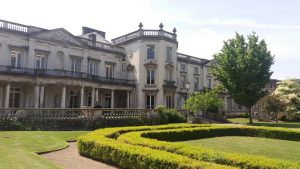
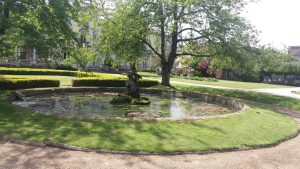
Just to amuse you, here are some recent ‘photos of Roehampton. I think technically these are of Southlands College.  The bit we were in, Whitelands, is separate from this but equally grand.

Students …

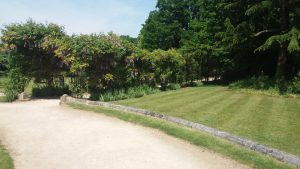
Approaching the wisteria tunnel.

Catching the tunnel at the right time of year.

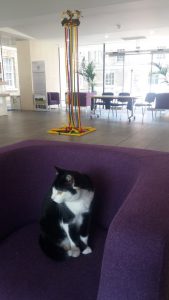
This is Whitelands where we met, and recent.  I’ll come back to both the cat and the maypole in other posts!


Visiting the Garden of Cosmic Speculation

Oh dear, I do struggle with, and side tracked by, technology.  With J and tnp I visited the Garden of Cosmic Speculation on Sunday.

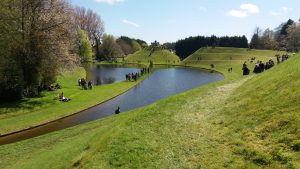
Snake mount (on right) and lake

I’ll try to write more about it but, though I’m not very pleased with my ‘phone ‘photos, it was a place that I thought told me emphatically: “now you really must sort out how to put up ‘photo galleries in your web pages!”  So I have tried.  It’s already gobbled several hours and I have only got less than a quarter of the ‘photos that I think might be worth putting up here, but because it’s taking so long, and stirring up so much frustration in various ways, I will pause here but with a link to the work in progress.  You can click through the ‘photos but this view seems not to show the labels I’d put on those ‘photos. Much still to learn.

[Best_Wordpress_Gallery id=”3″ gal_title=”Garden of cosmic speculation, May 2018″]

Oh dear, that gives a crazy picture of the gardens as those are the ‘photos I’m intending to have come up at the end of the gallery.  (It turns out to be much easier to build the gallery starting with the ‘photos on which you want to end and building forward: design error programmers!)  Anyway, that means they’re very much a niche sample of the speculations on offer there.  Ah well, onwards … later!

But what do you DO? Is it still CORE? Well yes, partly …

Hm.  I have been asked these questions rather a lot in the last few weeks.  I should stay in more!  No, that’s not the answer … and I doubt if a quick blog post on the topic will solve the problem either.

Why do I find it difficult to answer that question but also feel picqued and a bit irritated by follow up one (from people who know I helped create CORE: Clinical Outcomes in Routine Evaluation)? I sometimes make evasive jokes about not yet watching day time TV or just say that I’m a lady of leisure now I’m clinically retired.  However, the reality is that I am, as I have been for much of the last three decades, probably working 60 to 70 hours a week.  You’d think that’d mean I could say what I do but I’ve been hopeless answering that.  I think I ought to do better.

Well it’s true that I continue to work on CORE.  I maintain the CORE System Trust web site (https://www.coresystemtrust.org.uk/) and answer questions that come to me/us through that.  Most weeks that’s not a lot of work though lately, through some very irritating and I think unforeseeable technical problems, the site has consumed a lot of time (and the problems still aren’t fixed) and some of the incoming questions have required several hours not just a matter of minutes to an hour to answer.

Though the site and the Emails are a job, my main work is undoubtedly still CORE or CORE related, and some weeks probably eats 60 hours or so. Most of that is around the fact that I decided nearly 20 years ago that getting our questionnaires translated into other languages fascinated me and was a worthy job of work.  Now I’ve coordinated 25 of the 26 translations of the CORE-OM and all the 9 to 10 translations of the YP-CORE (nearly there with the Arabic YP-CORE).  However, I’m guiltily, shamefully, persecuted by being overdue with much work related to many of those translations.  Those collaborations take me into challenges doing statistical and psychometric analyses if/when sufficient data are collected with the translations to make that possible and when my collaboration has me doing that work (I’m usually the one most qualified to do that).  They also involve a lot of Emails and coordination and sometimes a trip to the country involved to sit and listen to people discussing the differences between many independent forward translations. Another little challenge is making up nice PDFs for the measures.  If the language requires different male and female versions, and often a “M/F” version then there are 18 different PDFs to make up as we have five shortened forms of the CORE-OM for different purposes.  Doing that is challenging enough for languages that use the “latin” alphabet and no accents, but when you get into accents and letters that don’t exist in the English alphabet things get fun, and copying and pasting right to left languages into InDesign is a horror, at least at first, I’m just about on top of that now though.

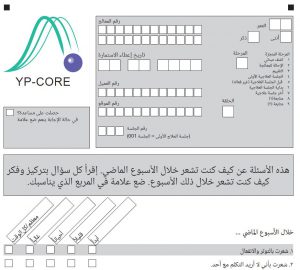
That’s the top of CORE-OM in Icelandic with at least one letter that used to be in English but is long gone. This next is the top of the Arabic YP-CORE and it’s still draft as it’s now in qualitative field testing (huge thanks to Sulafa for that).  You wouldn’t believe how difficult Adobe have made it to achieve that right to left type.

I’m proud of CORE and the translations though I am guilty and ashamed to be behind by months to years with things and one embarrassment answering this question is about that historical mess and how slowly I am getting back on top of it.  The other frustration is that I do want to do more than CORE before I pop my clogs (for non-English speakers, that’s a typically British euphemism for dying!)  A post or two about those other developing bits of work and as yet unstarted aspirations in the next weeks.

I hope unpacking this helps me clarify things in my own head.  Ah well, enough for now: I must get back into the slag heaps of shame and pits of deadly despair and guilt and nudge some of the overdue stuff onwards and stop other little things starting to build into new backlogs.

“Semigrating” to France

I’m not doing very well with this blog am I?  No!  Ah well, let’s see if it improves.

You may be thinking “He hardly posts at all these days and now he can’t even spell ’emigrating’!”  But not so, as that sentence nicely proves, I can spell ’emigrating’. However, I’ve just invented the word “semigrating” to describe the process of going to live a little over half the year in another country.  I know the rich have been doing it for decades to avoid paying taxes but I’m doing it in hope of gaining French and EU residency (and probably to end up paying taxes in France not in the UK even if that’s more expensive, which we think it might be).

Yes, it’s all about this damn Brexit.  We have owned a ski apartment in the French Alps since 2004, we bought it then as a pension for J whose career hasn’t created a pension for her as well as my NHS one did.  It also meant we could afford to ski quite a bit more than we would have been able to which, as J is very good at it and loves it, and as I am very late coming to it but learning (still), was great.  It’s meant that both children learned to ski, and tnp (yes, that’s the name he chose to go by in this blog!) to snowboard and we all love it there, 2000m up with a view of Mont Blanc out of the window.

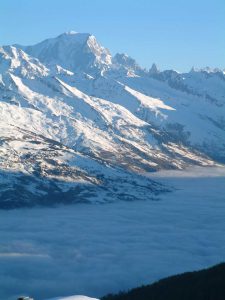
That’s that very view, back from 2004 and our first stay there.  Very unusually there’s not a wisp of cloud on Mont Blanc itself, usually it has a small hat or scarf of cloud all its own, rather as Gibralta often has.  Not so unusually, the valley is completely filled with low cloud.  It’s an odd feeling knowing that down there it may be a warm day but the sky will be completely cloud covered while up where we are the sun is blitzing down with no cloud at all.  (Though, as it was January, at 2000m it was probably well below zero … well, it needed to have been, it’s not going to be plausible as a ski area if it’s above zero much of the day at that time of year!)

I’m digressing because I love it there and love that view.  Anyway, the point of this blog post is tell anyone I haven’t yet told more personally, that I’m off to live at least half this pre-Brexit year, 30.iii.18 to 29.iii.19, up there, hoping to gain French and EU residency rights.

Nothing is certain given the madness of Brexit but, unless the negotiations savage this, it appears that if I own somewhere in France and spend more than half the year there, I should gain French and hence at least some EU residency rights and that they probably also extend to J and the children.  This seems particularly crucial for them as S had pretty much planned her future around developing her Spanish and French through working, and perhaps more studying, and tnp has skills that will find warmer and more opportunities within the EU than in the UK.

Above all, we all think Brexit is bonkers but fear that the Maybot and friends still cannot now bear to admit the folly of all this and plunge on.  It’s extraordinary watching all this with mounting evidence that the leave campaign’s manipulation of social media messages through what sounds to have been blatantly illegal use of personal data without consentmounts; equally suspicious evidence that they ruthlessly ignored the campaign funding law; and as official costings now put all the Brexit options on the table as losing the UK money.  Despite all this, they plunge on.  Never since the charge of the light brigade?  Into the contract of death rode the … wallies in charge.

Oops, it’s one thing to wander off theme with a glorious picture of Mont Blanc, that was just bile rising.  Down, down, back into the bowels bile, gall bladder do your work!  Back to the message.

Yes, I’m sorry if I’ve not managed to tell you personally and if it will make the slightest difference to your life but I’m semigrating.  From early June I will be off for three weeks, back via the SPR conference in Amsterdam and on to the EPCA conference in Edinburgh then back to the Alps until September.  Back then for a couple of weeks and back around Christmas but otherwise I shall be mostly up there or somewhere else in France (ironically, I can’t stay there in the ski season as we need to let the apartment and there are cheaper ways for me to be in France than foregoing that income!)

More on this in the next few weeks and I fondly imagine that I’ll blog much more while I’m up there, with more ‘photos of the views and my walks, as I will have few distractions at all while I’m there so I think blogging will be one way to stay in touch with the wider world.

A greater spotted woodpecker on the peanut feeder: bliss!

Well, I’ve been hopeless at keeping the blog going despite my good intentions.  Maybe I can let myself put up a post whose real content is in the title/subject line?  Yes.  Bliss it was indeed Thursday morning to look out of the kitchen window whilst making coffee.  S/he flew off to our false acacia tree where my daughter could see her/him too, and hopped up it in a wonderful, pure woodpecker way, then flew off, but we had insufficient angle to see the unmistakable undulating flight.

Yes, and it bears repetition: bliss it was … and it’s good too to just to post this.

“Don’t fence me in”

I had a wonderful experience last night.  “Don’t fence me in” is the title of a documentary film by Charles Maplestone, see page at Malachite Art Films. The British Library hosted a first public screening last night and early evening, in the hell of the London rush hours, I cycled across a drizzly and cold London from Roehampton to to the BL to get to the showing and was richly rewarded for my determination as the film is lovely.

The BL cinema isn’t huge but it was packed, I think there were probably 250 of us there but I was tired from my riding around and slumped near the front so perhaps I didn’t fully appreciate the size.  I was struck, the second time this week, by how old most of my peers at something were: I saw two late teenagers and a few 20ish folks but at 60 I think I was around the lower quartile of the age range!  I guess that makes sense as Fay Godwin was born in 1931 and died in 2005 and it felt as if many people who had come to the showing had known her and I guess she had an impact on many of us between about 1980 and her death 12 years ago.  I first bought one of her books (Islands with text by John Fowles) back in 1980 and I’m amused to see that the book was only two years old when I did.  Watching the film last night, so many of her photographs were immediately familiar to me and I’m intrigued, on searching my shelves quickly, to find that I don’t seem to own any more of her books (shame on me). Similarly, thinking through the exhibitions that were noted in the film and show up in internet references I can find, I don’t think I went to any of them (more shame).  So how is her work so familiar to me?

I think she has had a lot of publication in collected exhibitions perhaps but I’m a bit at a loss to answer my own question there and determined now never to miss any retrospective exhibitions that come up and to start collecting her books where I can afford them (apparently first editions of Remains of Elmet: A Pennine Sequence, which she did with Ted Hughes are now very costly collectors’ pieces so I can forget that!)  However, I think it may be that her work speaks so deeply to things I believe in that every image of hers I see, perhaps even when I may not have known it was hers, burns deep into my visual memory.

If you don’t know her work then I think the best way to get a sense of it is to go to the BL’s archive of her work That gives a sense of her genius with both people and places.  It doesn’t (yet) appear to make available her later colour prints which were almost absract (and which I hadn’t encountered before last night).  I wouldn’t bother clicking on the images there to enlarge them as they’re all stamped across the enlargements with three copies of a BL copyright statement.  I think she might have had very mixed feelings about that.

There are two layers to my deep, gut/bone pleasure in having seen the film (and having bought a couple of copies!)  One I think is that she was simply a genius with cameras and, unusually I think, both with portraits and with the landscapes. I think her landscapes are portraits too, portraits of land and the makeup artists who ever lived in/on it and impinged on it.  All that is dear to me and captures images that seem to me to be particularly important to capture.  However, watching last night I realised that the other issue is in the title: “Don’t fence me in”, and how much that imperative, let’s give it its proper punctuation: “Don’t fence me in!” matters increasingly to me.

Let’s start with the imagery and its genius.  One theme in the film, and coming across well in the interviews with her, and filming of her giving interviews and seminars, was that she came into photography from family snapshots.  There is that that simple intimacy in most of her work that is there in good family ‘photos: the photographer and subject are known to each other, there is trust and no worries about audience or property rights intrude on the recording.

I think that same intimacy is there in her portraiture but even in her most stark photos of the most barren bits of the UK: these places are family to her. Another aspect of what makes her special is that she was interested in how photos stood in relation to one another and in relation to words and to ideas. She was more a book and exhibition photographer than a single shot photo-reporter or all that her portraiture started in that single shot tradition.  As she gained confidence (I suspect) she created ways to work closely with writers and poets on the books she did, and she had the ability to wait and wait and wait to get the right image, with the right implicit stories for the viewers to take from it.  (She would wait for months as she describes for one glorious shot of a copper beech tree, completely naked in the depths of winter and reflected in the water below it, or again as she described for another photo of the white cliffs of Dover made completely white: utterly smothered in snow).

I feel she waited for the light and detail to be right as we might wait for the right tone, accent and staging for a really good Shakespeare play or any classic that can have multiple incarnations.  As we might wait for someone to read a poem in way that really does it justice.  There was a splendid short sequence in the film as the camera moves around a photo of hers (almost spuriously) where the sound track is someone, I am guessing Ted Hughes himself, someone with a glorious northern accent, reading the poem that goes with the photo in their book.  The poem is brilliant to start with, but spoken so well, in that voice, it sort of washes over you and hammers you in a way that I reading it, silently or aloud to myself, could simply never capture. The poem is short, one verse, a minute in the film, but I’m reminded of the experience of being part of a landscape as a storm batters over everything in sight. The storm, like that voice, hammers home an experiential moment into a sort of wedding: you now take each other, for ever, well, ’til death does wrench you off the globe; you will never exactly be the same again, and that setting won’t either, it will always remain enhanced in your memory by the whole experience.

So many of the places and people she took were intrinsically striking, “photogenic”, deserving memorialisation of each moment, but when Fay Godwin got the right moment, the right angle, the right focus, frame, contrast, they are celebrated, not just captured.  That’s genius and one particular theme in the film was that she recognised that the scenery of the UK that she caught is human scenery, as much shaped by from decades to millenia of human impacts and co-dependency, as her ‘photo is shaped by her particular choices with the camera (and the subsequent selection of the one negative to print, she took a very high number of negatives for any one print she used) and her choices in the dark room (or later on the digital image handling software and digital printer, even though she seems never to have given up starting from film).  There’s something there about the respect for our, sometimes puny, sometimes horrifically brutal, impacts on our countryside: even if there’s no animal more human than a sheep in her ‘photo, the shadows of humans in the walls, tracks, just the shaping of the land, are always there.

There’s a remarkable mix of the lonely and isolated aspects of human existence against the universal and ecological in all that.

So that’s my attempt to catch something of how the ‘photos move me and stay with me.  Now what about “Don’t fence me in!”  Fay Godwin became president of the Ramblers’ Association (1987-1990) and is clearly credited with having done much to help campaigns that led to “right to roam” legislation.  Another of her books I thought I had was Our Forbidden Land (1990) which is a superb invective against how much of the UK is in private hands, particularly in the hands of our military and our hereditarily wealthy.  Our “rights to roam” and any real equity of access have a long way still to go, nearly 40 years on the fight against excluding land ownership.  Take last year’s example: Donald Trump’s Scottish golf course destroying sites of special scientific interest. I think Fay Godwin’s passion, though focused on the land, was also about every attempt to fence in people’s thinking, she resonates with writers who don’t want to be told what to think and who invite their readers to roam with them (or to reject that invitation).

This burns with me though I guess cognitively rather than simply perceptually, expertientially.  Why do so many of us appear to want to be told what to think?  I think we need people like her, and so many of the brilliant writers she caught, to remind us that dry stone walls, even some fences, are certainly vital to live well with other animals and each other, but to remind us of the need for styles, gates, rights of way.  This was, and is, as true for the maps and places of the mind as it is for the those of the land.  We should all fight for is the right to think for ourselves.  I don’t believe in fighting for it to the point where we start killing each other, arguing lightly that our freedom to think gives us the right to kill others is to fundamentally abuse the real issue.  However, I’m damn sure we need to fight with words for our freedom for all our ideas to roam, to roam anywhere as long as it’s not simply in order to impinge on another’s thoughts. There’s a profound differences between the freedom of pacifist anarchism and equity from the “freedom” words of neo-liberals who really just want to fence others in and protect their own wealth and diktats.

Thank you Fay Godwin for so much beauty and passion, and thanks to the people who made the film, and made its showing last night happen.