This is quite a useful term related to effect sizes and pretty much means what it says.
Details #
It comes out of linear regression analyses but can apply to many other analyses. The basic idea is that across a lot of data a predictor variable, say clients’ age, might be related to something of you, say baseline CORE-OM score. So you plot baseline CORE-OM scores on your y-axis and client age on your x-axis and you are looking, in a linear regression analysis, for some fairly linear relationship, say that across the clients’ ages in your dataset, perhaps that is 18 to 45, you see a fairly steady fall baseline CORE-OM score across that age range. The linear regression will tell you the slope across your data. The “variance explained” is what it says: how much of the overall variance in baseline CORE-OM scores seems to be related to age.
Here’s a very unrealistic simulation of that situation simulating two different strengths of that relationship.
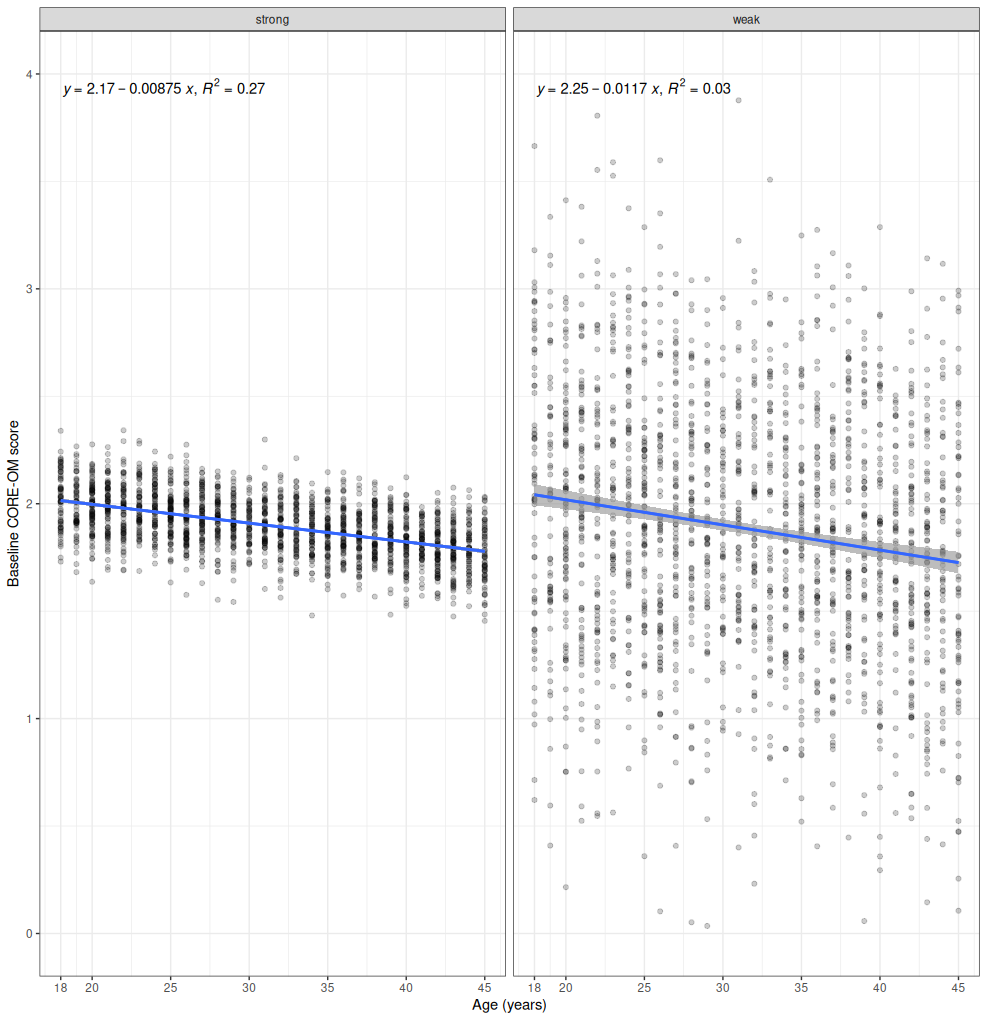
Those scatterplots of the scores against age have the regression equations at the top. On the left you see that the mean baseline CORE-OM score falls by a tiny .00875 for every extra year of the clients’ ages and on the right it falls by a slightly larger .0117 per year. However, the “variance explained”, that “R2” in the regression equations, is a much larger .27, i.e. 27% in the left hand simulation against only .03, i.e. 3%, in the right hand simulation.
How can a weaker linear relationship give a greater variance explained? As you can see, it’s because the variance around the means for each age is much smaller in the left hand simulation so the proportion of the overall variance “explained” across the full dataset by the clients’ ages is much higher.
Two things to remember:
- As ever “explained” here is about a correlation, it does not imply causation.
- As ever, beware the “ecological fallacy” of assuming that because your next client is aged 45 they will have a low baseline CORE-OM score. These are associations across many people, there is still variation between people.
Try also #
- Causality
- Dependent variable
- Ecological fallacy
- Linear regression
- Predictor variable
- Scatterplot/scattergram
- Slope (in linear regression)
Chapters #
Not covered in the OMbook.
Online resources #
None currently nor likely I think.
Dates #
First created 24.ix.26.

